
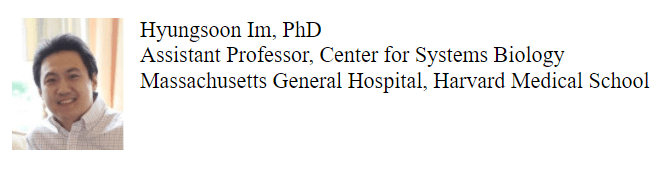
We received a 4-year grant from the KEIT ATC+ Program in 2020 as a foreign institution to collaborate with Healcerion Co. Ltd., a company developing portable ultrasound devices in Korea. Healcerion already has two FDA-approved portable ultrasound devices for the U.S. market. The project’s goal is to develop a next-generation smart portable ultrasound device powered by artificial intelligence to assist less-skilled operators. Our team at the Massachusetts General Hospital (MGH) consists of clinicians, engineers, and computer scientists to provide feedback on the next-generation portable ultrasound device, develop deep-learning algorithms, and test the developed device and algorithm in remote clinical settings.
The relationship between Healcerion and the MGH team first started back in 2018. The MGH biomedical engineering team developed a point-of-care cancer diagnostic platform and started a clinical trial in Botswana with funding support from the NIH (UH3 CA202637). One of the major bottlenecks in Botswana was lack of ultrasound devices and experienced operators in the hospital. Most clinicians had little experience with ultrasound devices. As a result, most biopsies were performed without imaging guidance. In 2018, we looked for companies, including Healcerion, providing portable ultrasound devices. After testing multiple devices, we determined to use Healcerion’s device because of its excellent imaging quality, portability, and cost. We used Healcerion’s SONON device for training local clinicians in the Princess Marina Hospital in Botswana, and the device has been used in the hospital since then.
In the current project, the Healcerion-MGH team will work on new AI-algorithms to improve image quality, show major organs, and detect a biopsy needle during operation. I envision that the proposed device will have strong needs in many low and middle-income countries. It could also expand the usability into local clinics and major hospitals in the rest of the world, especially during the COVID-19 pandemic. The KEIT ATC+ program was a key to the international collaboration, and we now expect important synergies.

Dr. W. Hong Yeo at Georgia Tech received a new grant from the Korea Evaluation Institute of Industrial Technology (KEIT) / Kyung-In Synthetic Company (KISCO). This project team includes a biomedical company, CVBio Inc, an academic partner (Georgia Tech Yeo Research Group in USA), and a clinical partner (Asan Medical Center). The awarded project aims to develop a minimally invasive trans-vascular intracranial pressure monitoring device and clinical platform for the prevention and diagnosis of cerebrovascular disease. Georgia Tech’s team, led by Dr. Yeo (Assistant Professor of Mechanical Engineering and Director of Human-Centric Interfaces and Engineering), will work on the study of soft materials, nanomanufacturing, and system integration to develop wireless implantable biosensors. CVBio, Inc will take the lead for large-scale manufacturing of medical stents and sensor integration, while Asan Medical Center will work on the device characterization and functionality validation via both in vitro and in vivo study. This is a 4-year project that started on May 1, 2020. The overall grant is $3 million, and Georgia Tech received about $470,000.

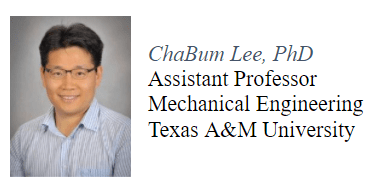
I am an assistant professor of Mechanical Engineering at Texas A&M University. I recently was awarded the industry-university-institute collaborative research grant from KEIT. It is a 30 months Korea Institute of Industrial Technology (KITECH)-led project grant (2.7 billion KRW) from April 2020 to December 2022. Texas A&M University (TAMU) was prorated 0.2 billion KRW. This project investigates the CFRP-metal bonding process for future automotive applications. The TAMU research team characterizes each layer’s geometry and deformation based on non-destructive testing methods. Here, the 3D stereoscopic thermography and magneto eddy current sensor will be used to measure the rivet configuration after riveting process and to measure the layer thickness and rivet surface profiles, respectively. This non-destructive testing workbench will be implemented with automated CFRP-Metal joining process, which will monitor the bonded part’s quality indices. The industry-university-institute research team has jointly written journal papers and has delivered conference presentation. In particular, we hold a virtual meeting every 2 months to share the ideas and to update the achievements. After the COVID-19 pandemic ends, I will travel to South Korea to demonstrate our prototypes and share research outcomes with the team.
If you have any questions regarding KEIT funding programs, please contact Dr. Joseph Kim at jin5176@gmail.com.
Dr. Joseph J. Kim
KEIT Director for KSEA
Professor, California State University Long Beach
 KSEA e-Letters