KSEA 30th President (2001-2002)
KAUPA 10TH President (2005-2006)
By Kang-Won Wayne Lee, Ph.D., P.E., F. ASCE
The 36th KSEA President (2007-2008)
The 12th KAUPA President (2014-2017)
Professor Emeritus Nakho Sung of Tufts University passed away in Korea on October 22, 2022. He is a beloved husband of Prof. Emeritus Chong Sook Paik Sung of University of Connecticut and is loving father of Andrew J. Sung and his wife Jinsil of Lexington, MA. He is also survived by two grandchildren, Marcus and Alexis Sung. Dr. Sung was born in Seoul, South Korea in 1940. He graduated from Seoul High School in 1960 and attended Seoul National University, where he graduated with a degree in Chemical Engineering. He obtained a master’s degree in Chemistry from the University of Chicago in 1967 and his Ph.D. in Mechanical Engineering from MIT in 1972, where he met and married his wife, Dr. Chong Sook Paik Sung.
From 1978 to 2013, Dr. Sung was a Professor of Chemical and Biological Engineering at Tufts University and served as the Department Chair from 2007-2011. He also founded the Laboratory of Materials and Interfaces at Tufts, created several new materials sciences courses and supervised dozens of undergraduate research and Masters and Ph.D. thesis projects. Many of his former students have gone on to become Professors or other leaders in their respective fields across the world. Over his prolific career, he published more than 100 technical papers and chapters, edited a book, and held multiple patents. Dr. Sung was also an active member of many professional organizations, but none more so than the Korean American Scientists and Engineers Association (KSEA), where he served as the 30th KSEA President and continued to support the organization well into his retirement. Dr. Sung also served as the 10th President of Korean American University Professors Association (KAUPA). During his career, Dr. Sung was awarded several honors, including being inducted as an elected member to the prestigious Korean National Academy of Engineering and receiving the National Medal of Honor in Science and Technology with highest distinction – the highest national honor bestowed upon individual scientists and engineers in South Korea.
Dr. Sung was beloved by his friends, family, students, and colleagues, both locally and abroad. He was an avid golfer and was always willing to give tips to anyone he played with. He appreciated all types of cuisine and took great pleasure in eating well with his family. In particular, he adored his grandchildren and loved watching them play baseball, softball, and golf.
In 1997, a financial crisis (IMF trauma) started in Korea, and KSEA encountered a real hardship in fund raising since then, causing a severe problem in previous administration. Also, a technology espionage issue on artificial diamond manufacturing between IL-SIN Industry and GE triggered an FBI review of many science and engineering organizations tied to foreign nationals, and this led to FBI interviews of some officers and members of KSEA. This created undue concerns on many members, especially those working in Government and Federal labs, and the membership of KSEA dropped significantly. Both factors negatively impacted on KSEA, and member participation experienced a substantial downfall. Major concern when he became the 30th President in 2001 was how to restore the stature of KSEA and strengthen the organizational infrastructure, thereby sustaining a healthy growth of KSEA. Top priority was fund raising. Second was to create new programs, thereby increase the member participation in KSEA activities. Third is to enhance services to the community.
Although I met Prof. Sung before, I had an opportunity to work with him more closely when I worked as a Publication Director (Editor in Chief) for KSEA Letters. As a part of an effort to increase membership and member participation, KSEA Letters, the only official publication, was published in five issues, a record in KSEA history, including the Memorial Issue for Professor Inyong Ham (Vol. 30, No.2). Thus, extra efforts were made by the Publication Directors under his instruction.
The 2001 US Korea conference (UKC) organized by KSEA in collaboration with Korea Federation of Science and Technology (KOFST) and Korea-US Science Cooperation (KUSCO) was held at MIT in Cambridge, Massachusetts on August 10-12. I had another opportunity to work as Local Organizing Committee Chair, and the conference was a great success, attended by more than 400 people, 100 from Korea and 300 from U.S. and over 260 people have presented technical papers in 4 Symposiums with 24 Technical Sessions, 3 Special Forums, one Workshop and a Career-Job Fair. Attendance was the largest up to year 2001, and we were able to draw a broad support from many Korean organizations, and the level of interest on KSEA affairs from Korea appeared to be resurrected. Industry sponsors and exhibitors expressed their satisfaction. UKC 2001 contributed very much to the revitalization of KSEA. A major grant from SK Telecom enabled to support travel expenses, and the participants enjoyed free meals, Friday Gala dinner, sponsored by LG, and Saturday lively entertainment of Boston Harbor Cruise dinner, sponsored by SK Telecom. Three-day program was run smoothly, thanks to the efficient work coordinated by staffs from HQ and New England Chapter and Local Organizing Committee members. Proceedings of the conference were made available in CD form for the first time.
Inauguration of National Mathematics Competition (NMC) was launched on April 20, 2002. This event became most popular activity among young Korean Americans and their parents. NMC became a KSEA signature program, making important contributions to KSEA publicity, the local Chapter vitality, member participation, and to community service. For the first time in 30 years, KSEA officially launched Annual Awards (KSEA Letters Vol. 30, No.4, p8), starting with Outstanding Service to KSEA Award and Entrepreneurial Award. Inaugural Awardees were Dr. Hyung-Sup Choi (former Minister of MOST), Dr. Seung-Soo Han (former Prime Minister, Chief of Staff to the President of ROK, Chair of UN), and Prof. Shoon Kyung Kim (1st President of KSEA). Dr. Byiung Jun Park and Dr. Steve Kim were recognized for their entrepreneurial achievements.
A campaign for creating private donor named scholarship was successful in generating two accounts. “Chunghi Hong Park Scholarship” has been endowed with $50,000 to support women students and “Yohan & Rumie Cho” Scholarship was endowed with $25,000 to support students in Information Science and Technology area. Effectively, these scholarship fund increased by more than 50%.
On October 18, 2001, KUSCO Board, led by the Chairman, Dr. Jung Duk Kim (Director of Korea Science and Engineering Foundation or KOSEF), proposed a major by-law change to transform KUSCO as an independent U.S. entity, and in the process, KSEA’s involvement, well defined in the original by-law, is completely eradicated. This shocked everyone and 30th Administration coordinated an all-out fight, and eventually revived the KSEA-KUSCO relationship, including retention of two Board seats from KSEA. In December of 2001, a special workshop was held at HQ for three Committees, Long Range and Planning, Rules, and Award & Discipline, as a part of a strategy to strengthen the authority and responsibility of the Committees. The workshop generated many ideas for strengthening KSEA. The Chapter President Committee was created to effectively support the activities of Chapters and Branches and better communication between HQ and Chapters and Branches. Lastly, not least the Young Generation Leadership Forum was held on May 11, 2002 (Please see the picture below).

Overall, 30th Administration made a significant impact on restoration of KSEA stature and enhancement of the organizational infrastructure. It was my pleasure and honor to be part of the KSEA 30th Administration, the experience helped me to jump up KSEA to one of best Korean American organizations when I became the 36th KSEA President in 2007.
Prof. Sung also served as the 10th President of Korean American University Professor Association (KAUPA), a sister organization of KSEA from January 1, 2005, to December 31, 2006. Prof. Jungho Kim of University of Maryland served as Financial Director, Prof. Hae Soo Oh of University of North Carolina – Charlotte served as Publication Director, and Prof. Ki-Hyon Kim of North Carolina Central University continued serving as Conference Director. A 2-day Conference with a theme of “The U.S.-KOREA Relations in the 21St Century: Challenges and Prospects” was held jointly with International Council on Korean Studies (ICKS) at George Washington University on October 6-8, 2006. Professors Yoon-Shik Park and Dr. Soon Paik were program Co-Chairs.
When I accomplished my job successfully as the 36th KSEA President on June 30, 2008, Prof. Sung introduced the 11th KAUPA President, Prof. Sunwoong Kim in 2012. Through the strong leadership of past presidents, noticeably Prof. Sung and officers, and more importantly, the passion of its dedicated members, the KAUPA has become one of the most versatile professional organizations. To make KAUPA more encompassing and at the same time, discipline specific to our respective members and colleagues (while remaining relevant to the Korean communities in North America), venues were expanded to cover both topical and inter-disciplinary conferences, symposia, and workshops. Thus, it promoted participation of myriad of K-A professors in various fields of accomplishment. For example, thanks to Prof. Sung’s encouragement the 11th President hosted a special symposium on Dokdo in 2013 as can be seen from the picture below.

To strengthen connections with existing K-A professional societies, noticeably KSERA, KAUPA promoted an open environment that reflects a professional association exuding quality reputation. This was accomplished by the type of events and conferences, distinguished guests, speakers, performers, and artists. Such quality was also reflected in new relationships that KAUPA forged with professional societies elsewhere, e.g., KSEA and recognition that KAUPA garnered from accomplishments. Eventually, this effort translated into more outstanding professors joining as members. Further these changes also created more incentive for existing members to actively participate in activities. For example, 17 KAUPA and 3 family members made to the Dokdo Opinion Leaders trip to be familiar with real issues through the invitation of Dokdo Foundation on July 22-25, 2014. ROK Ministry of Foreign Affairs (MOFA) also invited Dokdo Island and East Sea experts to form a network and to uplift the understanding of Dokdo Island and East Sea issues through working with KAUPA and respectful experts. Delegates included 6 KAUPA members and 6 non-Korean Heritage scholars who have expertise in International Law (Maritime or Ocean Law), History, International Politics and Geography. Ten delegates met with Korean experts including members of Korean Society of International Law, made presentation for and discussion with them about the Dokdo and East Sea issues in depth in Seoul on December 7-13, 2014, at the Northeast Asian History Foundation (NAHF).
KAUPA and KSEA jointly carried out a database project for KOFST in May 2015. To expand membership, KAUPA was more proactive in reaching out to K-As whose primary or sole mode of communication is English, i.e., 1.5 and 2nd generations. Again, Prof. Sung’s encouragement KAUPA successfully held an International Conference on Dokdo at Omni hotel in Providence, Rhode Island on June 6, 2015, as can be seen in the picture below. Titled “Sovereignty over Dokdo from the Historical, Political and Cultural Prospective,” this conference covered myriad of issues on Territorial and Maritime concerns. More than 60 scholars including KSEA delegates attended the conference to share their ideas in two sessions and a roundtable discussion. The keynote speaker was Prof. James Kraska from the Stockton Center for the Study of International Law at U.S. Naval War College. The common interest to promote the betterment of our society through KAUPA and KSEA would build a formidable coalition consisting of both the K-A and Korean Canadian (K-C) Professors.

Interaction with Prof. Sung was continued through Soul National University (SNU) and Seoul High School Alumni Association. Interestingly, Prof. Sung also supported Three High School Golf Tournament in New England not only having good time but also unifying all Korean Americans. The picture below was taken after a golf outing in October 2016.

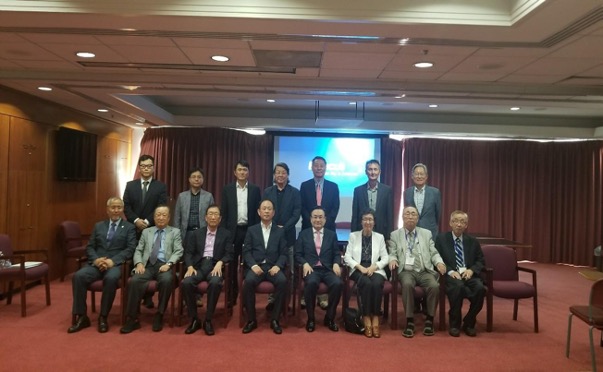
The KAUPA General Assembly was held at the KSEA HQ on August 13, 2017, and Prof. Jae Kwang Park of University of Wisconsin – Madison was elected as the 13th President. Some key members had an opportunity to take a memorable picture as can be seen below.
Through Prof. Sung’s encouragement, KAUPA tried to work with KSEA as much as possible. For example, KSEA and KAUPA reached out to K-As whose primary means of communication is English, e.g., President Mun Y. Choi of the University of Missouri System and Prof. Tom Oh of Rochester Institute of Technology, Prof. Philip Kim of Harvard University and Prof. Eugene Y. Park of University of Pennsylvania et al. One of activities was forming an environment for better scholastic and career development for excellence, e.g., Nobel Prize winning level.
A memorial service was held at the Douglass Funeral Home, 51 Worthen Rd. in Lexington, MA on Tuesday, November 15th at 3pm. In lieu of flowers, his remaining family recommend making a donation to the KSEA Scholarship Fund in Memory of Professor Nakho Sung here: https://www.paypal.com/donate/?hosted_button_id=ZM3BEELSDZABE

In summary, Prof. Sung was not only one of respectful educators and researchers but also broad-minded contributors to our societies, particularly ROK and USA. We will miss him long time.
 KSEA e-Letters