<Monthly Chosun, July 2023> (한글기사링크)
“To become a scientific powerhouse, active utilization of overseas compatriots is essential,” says Prof. Moon-won Suh, known as ‘Lee Kun-hee’s private tutor.’ /Hye-yeon Chung, Monthly Chosun, hychung@chosun.com; translated by KSEA Publication Directors
- “Korea must become the world’s number one powerhouse in technology and innovation.”
- The Korea-America Science Cooperation Association is promoting the establishment of the ‘Sejong Science and Technology Innovation Center’ in Silicon Valley.
- “Instead of worrying about talent outflow, we should focus on attracting talent.”
- “Teenager Lee Kun-hee is pure, creative, and full of imagination.”
Prof. Moon-won Suh 徐文源
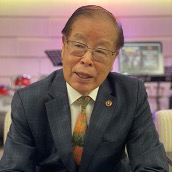
Born in 1936. Graduated from the Department of Fiber Engineering at Seoul National University. Obtained a master’s degree in Fiber Engineering and a Ph.D. in Statistics from North Carolina State University in the United States. / Worked as the Chief Statistician and OR Researcher at Burlington Industries, Charles Cannon Endowed Professor at North Carolina State University, invited professor at the Department of Statistics at Seoul National University, invited professor at the Graduate School of Science and Technology Policy at KAIST, invited endowed professor at the Department of Applied Mathematics and Statistics and the Department of Management at the State University of New York, Chairman of the University Development Special Committee, President, Honorary Member, and 50th Anniversary Committee Chairman of the Korean-American Scientists and Engineers Association (KSEA), President of the American Fiber Society. Currently serves as Honorary Endowed Professor at North Carolina State University, Honorary Member of the American Statistical Association, and Lifetime Member of the Korean Academy of Science and Technology / Received commendations from the Ministry of Education of the Republic of Korea, the Order of Service Merit Peony Medal, the Order of Science and Technology Merit, and the ASTM DeWitt Smith Medal.
In October 2021, an 85-year-old senior professor boarded a flight to Korea. At that time, the COVID-19 situation was severe, and all incoming travelers were required to undergo a mandatory 2-week self-quarantine. While it was a challenging task for the younger individuals, it posed no problem for the elderly professor.
“I will definitely attract substantial funds from the Korean government and companies. With this money, I will create a forward operating base in Silicon Valley, where Korean small and medium-sized enterprises and ventures can make inroads.”

I met Prof. Moon-won Suh on June 6th at Gwanghwamun in Seoul. Prof. Seo was brimming with enthusiasm for his vision. During his self-quarantine period, he received the heart-wrenching news of the passing of Chairman Lee Kun-hee, the Korean company he deeply cherished and a former disciple, but he couldn’t attend the funeral. After completing the two-week quarantine, he met with fellow scientists and successors in the field, Dr. Tae-sik Lee and Dr. Se-young Ahn, along with Dr. Byung-kyu Park, the president of the Korean-American Scientists and Engineers Association (KSEA), and explained the purpose of his visit to South Korea to officials at President Moon Jae-in’s administration.
His grand plan was to establish a ‘Sejong Science and Technology Center’ in Silicon Valley, USA, and foster cooperation among Korean-American scientists and engineers to create a pathway for Korean venture companies to enter the US market. He referred to this ambitious initiative as the ‘Landing Operation US’ According to his vision, to conquer the vast US market, Korean small and medium-sized enterprises, as well as research projects, need to move beyond the traditional business model and establish a significant presence in the US. He explained, “As in any war, to emerge victorious, we must first gain strategic advantage,” emphasizing the need to actively utilize Korean-American scientists and engineers who can effectively comprehend and promote these ventures. However, the journey was not without its challenges, with the Minister of Science and ICT changing three times.
In June of the previous year, after a change in administration, KSEA held an inauguration ceremony for the ‘Sejong Science and Technology Innovation Center,’ reigniting the project. Recently, the Presidential Office of Policy Development for People signed a ‘Business Agreement for Overseas Talent Recruitment and Attraction’ with KSEA and others on May 17th, aiming to proactively attract science and technology talents working abroad. During a meeting with President Yoon Suk-yeol in April, Young-Kee Kim, the president of KSEA, presented information about the ‘Sejong Center.’ This marked the first time the Presidential Office of Policy Development for People entered into a business agreement with an overseas Korean professional group.
The Korean-American Scientists and Engineers Association (KSEA) has 36 branches and divisions with 30,000 scientist members.
“It’s time for Korea to start the ‘Second Miracle of Han River’ in Silicon Valley. The 30,000 Korean-American scientists and engineers in the United States will actively support Korean venture companies, research institutes, and universities by helping them find investors and market their technologies in the U.S. at any time,” Professor Moon-won Suh consistently conveyed this message.
Currently serving as the Charles Cannon Distinguished Professor of North Carolina State University, Prof. Moon-won Suh is renowned in the fields of fibers, textiles, and statistics within the domestic scientific community. He is widely recognized among scientific pioneers and has earned remarkable achievements in the United States. Dr. Suh became the first Korean to be honored as a Fellow of the American Statistical Association in 150 years and became the President of the American Fiber Society for the first time in 60 years, achieving a rare status as a distinguished member. He was also appointed as the first Korean incumbent Endowed Professor at the College of Textiles, North Carolina State University, in 120 years. Additionally, he served as an editor or associate editor for three prestigious journals in the UK and the U.S., publishing 260 research papers over 40 years. To understand him better, one must first learn about the KSEA, founded in 1971. The organization was established through the generous donation from Kim Hyung-gi, the Director of the International Technology Cooperation Division, when he accompanied the late Choi Hyung-seop, then-Minister of Science and Technology, during his visit to the United States in 1971. Dr. Moon-won Suh is a member of the North Carolina branch, and according to his membership sequence, his KSEA identification number is ‘Moon-won Suh-252.’ The association has contributed to the advancement of science and technology in Korea through academic exchanges, technology transfers, fostering scientists, and advisory activities, celebrating its 50th anniversary in 2021. Currently, it boasts over 30,000 scientist and engineer members across 37 branches and divisions in the United States.
Establishing the Korea-U.S. Science Cooperation Center (KUSCO)
In 1994, Dr. Moon-won Suh, as the president of the KSEA, achieved a remarkable feat by hosting the first annual US-Korea conference (UKC) in the United States, revitalizing KSEA with a renaissance. The one who assisted the “penniless organization” was Chairman Seung-yeon Kim (金昇淵) of the Hanwha Group. While a noisy meeting was taking place outside the chairman’s office, Chairman Kim suddenly appeared. He had been hearing Professor Seo’s call for donations and the talk of “only the chairman can decide such a large sum of money.”
“I will take responsibility for all the costs of the first conference. Since the contracted hotel is not up to par, move it to the 5-star hotel ‘Maplewood’ in DC,” Chairman Kim said.
“Chairman Kim, that’s not possible. This is the first ‘Annual General Meeting and Conference’ held after 23 years since the founding, and it must continue next year and the year after that. If there is any surplus budget, we should use it for next year’s conference,” Professor Suh firmly replied.
Hanwha paid for all the conference expenses, and more than 800 people from across the United States and Korea gathered. This led to the wider recognition of KSEA in Korean society. Dr. Suh, buoyed by the success of the conference, took a flight to Korea the following spring. Coincidentally, it was just after Han Seung-soo, who had invited conference attendees to the ambassador’s residence for dinner, was appointed as the Secretary to the President at the Blue House. Dr. Yoo Doo-young, Dr. Ahn Se-young, and Dr. Ji Yong-sung, who accompanied Dr. Suh, clashed with him over how much financial assistance they should request from KSEA. Dr. Suh was resolute.
“Hey, I am the president this year, and the Blue House is not a place where we go begging for a few tens of thousands of dollars. I will ask for 10 million dollars, and you either join me and raise your voice, or you can just relax on the lawn. I will go in and come out alone!”
Dr. Moon-won Suh requested $10 million in support from Secretary Seung-soo Han.
“First, we need a proper KSEA headquarters building in Washington, and second, Korean small and medium-sized enterprises, unfamiliar with the US, should be able to come anytime and seek advice from KSEA members. This is also an investment in not only Korean scientists but also in the second and third generations of Koreans growing up in the US,” he explained.
The following year, $7 million crossed the Pacific, and in 1996, with investment from the Korean government, the Korea-U.S. Science Cooperation Center (KUSCO) was established in Vienna, Virginia (currently KSEA headquarters). President Kim Young-sam announced the decision to grant KUSCO to KSEA during the 1995 UKC held in Los Angeles. Dr. Suh, who led the project, received the Order of Service Merit Science and Technology Medal from the South Korean government.
Yeoinsook (Inn)

He has been assisting in the establishment of the ‘Sejong Science and Technology Innovation Center’ for the past four years. Occasionally, his friends would say, “You’re an American, what do you know about Korea? Stop talking nonsense and just drink makgeolli (traditional Korean rice wine),” which he disliked, so in 2018, he regained Korean citizenship. “I am now speaking not as a Korean-American scientist but as a Korean citizen, focusing on contributing to the country.”, Dr. Suh said.
The project that Dr. Suh envisions for the ‘Sejong Science and Technology Innovation Center’ involves investing $100 million in Silicon Valley, California, securing a building to create a startup center, and utilizing Korean-American scientists to develop Korea into a leading global technology nation and a “Science Powerhouse.” To achieve this, the project aims to harness the 50-year history of KSEA and the potential of 3.5 million Korean-Americans from the 1st to 4th generation. The goal is to build infrastructure that will commercialize ideas developed by Korean SMEs, universities, and research institutes in the US, which is the world’s largest consumer market. The project involves the participation of 30,000 members with master’s and doctoral degrees affiliated with KSEA in research, development, and commercialization of products. Dr. Suh proposed that the Korean government would contribute 45%, and conglomerates, SMEs, universities, etc., would contribute 45%, while KSEA and the Korean-American community in the US would contribute 10% of the project’s cost. Dr. Suh said, “If I can convince President Joe Biden and the federal government to provide an additional $100-200 million, it would be the icing on the cake.”
“Two years ago, amid the COVID-19 pandemic, I proposed to the Blue House to establish the $100 million Sejong Science and Technology Innovation Center as a 50th-anniversary project of KSEA. The response was different from that of 1995. When asked, ‘Why does KSEA, which has been around for 50 years or more, suddenly need a center building?’ I answered, ‘It’s not that KSEA needs it, but it’s necessary for Korean companies.'”
― Isn’t it a natural question since it involves government budget allocation?
“It’s a reasonable question, considering that the government budget is involved. In 2020, I met various people including scientific community leaders, former and current members of the National Assembly, and ministers, and told them, ‘Now is the time for Korea to look far ahead for the next 50 years and make big plans. This center is absolutely necessary for Korea to become a prosperous nation in science and technology.’ There was no one among the 50 or so people I met who opposed the idea; they willingly agreed to participate. Now, the establishment of a foundation for domestic fundraising is in progress. We need to continue promoting until major investors come forward.”
― What are the distinctive features of the envisioned center?
“The unique feature of the center I envision is that it will serve as a space where Korean SME research institutes, engineering universities, university-affiliated research institutes, government-funded research institutes, corporate research institutes, and venture companies in Korea can come to the US for technical consultation, seek collaborative partners, and conduct marketing activities. I want to call this place ‘Yeoinsook,’ which means a place where you can stay for a few nights anytime. I believe it is the responsibility of the government, industrial associations, and trade associations to create such a small space for Korean companies.”
“Building at the Heart of Silicon Valley to Attract Investors”
― There must have been institutions like this already.
“There are many government-promoted centers, but there is no place that operates in this way. There is no place that takes responsibility for arranging consultations with scientists. When it comes to commercializing products in the local market, US investors don’t need to come to Korea; they can meet in this ‘Yeoinsook‘ in the US. With the cost of inviting Nobel laureates to Korea to give a few lectures, we can provide facilities and services for partners to meet and discuss product planning, etc. If US-based SMEs with intentions to enter the Korean market come to this center and meet with Korean companies, wouldn’t that be efficient?”
― Building in Silicon Valley also has symbolic significance.
“From 1st to 4th generation Korean-Americans living in the US will feel a sense of pride and connection to their Korean heritage when they look at this building, and it will lead them to have a desire to help Korea. Among them, there should be Nobel laureates, and they should be able to connect and collaborate with Korean scientists and companies.”
― For government budget allocation, there needs to be concrete short-term achievements.
“The most common response I heard from government officials was, ‘What immediate benefits does Korea gain from building a facility in the US?’ The answer to such skeptical questions is simply ‘We have to fight and win.’ We cannot occupy the high ground with shortsighted approaches. Should we wait to see results just for next year? Those who only test the waters and hesitate cannot achieve great success. To win in the Fourth Industrial Revolution, Korea needs strong support in science and technology, and for that, Korean scientists alone are not enough. We need to provide opportunities for Korean-American scientists to assist Korean companies, and Korean companies should fully utilize their capabilities. Considering that Korea has the lowest birth rate in the world, I believe this approach is not a second-best option but the only way forward.”
“To achieve the leap towards a scientific powerhouse, we need to mobilize overseas talents from the 2nd to 4th generations.”

Dr. Suh’s opinion remained consistent. To realize the dream of making South Korea a strong science nation, he emphasizes the need to actively utilize foreign talents.
“In the United States, they even change immigration laws to grant green cards and citizenship to needed foreign talents. Countries like the US, Canada, and Europe are bold in reforming, even if it means opposing voices or challenging the national sentiment.”
― Although you have completed your education in Korea, would overseas 2nd and 3rd generation Koreans be willing to help Korean companies?
“There are approximately 3.5 million Korean descendants living in the US. In reality, just in California alone, there are many surplus scientific talents who, upon retirement, desire to actively contribute to Korea but are not given the opportunity. I know someone who specializes in nuclear power with expertise in atomic bomb disposal technology. He would like to contribute to Korea, but his skills are being wasted. Although they left Korea long ago and established their lives in the US, their affection for Korea remains unchanged. If both the Korean and US governments jointly create opportunities for these individuals, they will be able to achieve remarkable things for many impoverished countries around the world.”
― It seems like a significant undertaking that requires substantial funding.
“The government can justify it with long-term vision, while companies can think of it as ‘returning wealth to the local community.’ Large corporations like Samsung, Hyundai, LG, SK, and Hanwha have already become global companies transcending national borders or are striving to become one. If they have made profits in a particular country, returning some of those profits to the country is a sustainable marketing strategy for generating even greater wealth. Returning to society means not just giving away money indiscriminately but participating in public projects that the people of that country desire. The example of the Bill & Melinda Gates Foundation is a good one. Korean conglomerates should also have this level of maturity and look at the global market. KSEA is not asking for money; we simply want opportunities to participate in such public projects of the Korean government and companies.”
― Many companies would want to enter the center of the world, the United States.
“Korea is not only talking about the Fourth Industrial Revolution right now; it feels like we’ll have the Fourth and Fifth Industrial Revolutions every time we wake up. Korea may be small in terms of land area, but its economic power is tremendous. However, from an external perspective, it seems difficult to further grow this large economy with just its technological capabilities. Korean universities have developed significantly, and their research capabilities have grown impressively. However, for high growth, there is an issue of quality and, at the same time, an absolute number of technical personnel. Therefore, as someone living around the world while supporting my homeland, Korea, I believe we should pay attention to and seek help from the countless overseas Koreans who wish to provide support. We must calculate and utilize their numbers and capabilities, as well as fully leverage the non-Korean Korean networks in their respective countries.”
“The scientists and engineers in Korea are significantly insufficient.”
― Do you believe that Korea’s own scientific and technological capabilities are significantly lacking?
“That’s right. We have elite forces, but when it comes to advanced talent needed for Korea to reach G7, G6, or G5 level, we are woefully short. Moreover, the number of students studying for their doctorates in the United States is declining. In 2010, 1076 science doctoral degrees were awarded to Korean students studying in the US, but by 2020, this number decreased significantly to 709. China sends about six times more science students, and India sends twice as many to the US compared to Korea. Furthermore, according to a report from the Korea Federation of Science and Technology Societies, 65% of these doctoral graduates choose to stay in the US. In the past ten years, around 10,000 science doctoral degree holders left for the US, but only 350 return each year. In the face of Korea’s low birth rate issue, it won’t be resolved overnight. In this context, the Korean-American Scientists and Engineers Association and I believe that if we connect overseas Koreans directly to Korea’s scientific and industrial fields, they can contribute significantly to Korea’s progress on the world stage.”
Dr. Suh stated, “For Korea to achieve another miracle, we must acknowledge the fact that good universities in Korea alone cannot compete with China and India. We need to recruit and utilize talent from other countries without regard to nationality.”
― Korean companies like Samsung establishing factories in Texas, and Hyundai building plants in Alabama, show their significant push for expansion in the US.
“While we’ve heard about Korean companies building factories in the US, we rarely hear about them establishing large-scale research centers. Americans view GSK as a multinational research hub based in the UK and Siemens as a multinational company based in Germany, not as UK or German companies. I hope that Korean conglomerates will soon create such research centers in the US. This way, talented minds can gather regardless of nationality, and we can easily recruit top talents locally. Some may express concerns about technology leakage if we establish research centers overseas, but if we are afraid of that, we cannot become global companies. All technologies eventually get leaked, and leaked technologies become practically useless. Technologies published in famous journals are no longer secrets. The reason for publishing is for professors to increase their publication count and gain recognition, not for making money through core technologies. We mustn’t be too secretive about our core technologies; otherwise, they become widely known sooner or later.”
― So, you are suggesting that, for example, instead of hiring ordinary workers at Samsung’s US factories, they should establish good research centers there to attract high-level talents.
“For a company to thrive, its research centers must thrive. Today’s Korea is the result of corporate miracles, driven by the sweat and efforts of scientists and engineers. Smart young people should continue to flock to STEM fields, and if we can’t meet the demand domestically, we must supplement it from overseas. George Washington University in Washington, D.C., sends special envoys to China for research and marketing activities. China has established ‘Confucius Institutes’ in many American universities, though they have lost influence lately, and Japan has long established ‘Japan Centers’ in various US states at the government level. Besides the natural duty of alleviating the pain of overseas Koreans leaving their homeland, the Korean government’s newly established Overseas Korean Foundation should also discover buried scientific talents in the local areas, lead scientific diplomacy, create connections between Korea’s major and small companies, and provide a foundation for overseas Koreans to advance to the world stage, thereby wishing to launch new businesses that suit the 21st century.”
Hope President Yoon aims Korea as a science powerhouse
Dr. Suh argues that many Korean companies should expand their presence in countries in addition to the United States. He cited an example of the S Textile Company, which acquired a small factory in U.S. and is now operating it as a local corporation. When the chairman of S Textile asked Dr. Suh if expanding to the U.S. would be profitable, he advised, “The U.S. is the world’s largest market. Make a landing first and then pursue profits. Isn’t it the right time to plant the flag?” Currently, S Textile is expanding its production facilities because it cannot meet the growing demand in the U.S.
“Of course, not all companies should go abroad and succeed. However, how long should they continue to be ‘peddlers’ in the world’s largest market? Instead of recklessly landing in the U.S., we need the proposed ‘Sejong Science and Technology Innovation Center.’ Especially in the current situation of strained U.S.-China relations, it presents a golden opportunity for us to land in the U.S.”
― The idea of conquering the U.S. mainland with science and technology may sound a bit idealistic.
“It’s not about defeating the U.S. mainland with science and technology; it’s about gaining greater profits in the biggest market. I am not a daydreamer but a scientist speaking realistically about what is possible. I make a challenging request to all companies, ‘Increase your profits tenfold within the next five years.’ It’s difficult, of course. If they can’t plan that, they should step down from their positions. The Han River Miracle has not happened just once but keeps happening every year. I tell skeptical people, ‘Let’s create an undersea tunnel through the Pacific as a blood vessel, making the diaspora’s veins into arteries flowing back to Korea.’ With such dreams, ‘T1 Korea’ and ‘Scientifically Advanced Nation’ can be achieved.”
― T1 Korea?
“It means putting G7, G1 aside and making Korea the world’s number one nation with technology and innovation. If President Park Chung-hee succeeded with ‘Science Country,’ I hope the Yoon Suk-yeol administration becomes the main player in ‘Scientifically Advanced Nation.’ In his inauguration speech, President Yoon emphasized science, technology, innovation, and cooperation repeatedly. Two years ago, KSEA created the initial draft of the ‘Sejong Science and Technology Innovation Center’ and launched it last year. When conglomerate CEOs visit the U.S. or abroad, I hope they take scientists with them, emphasizing the importance of science. While Korean sports, K-pop, and automobiles are flying flags in foreign countries, why can’t our technology and science conquer the world?”
― You hope that the Yoon administration will focus more on science.
“President should inspire big dreams in the people and make difficult demands. In May 1961, just before my landing on U.S. in 1962, President John F. Kennedy planted the dream of conquering the moon within ten years in the minds of the American people. In his inauguration speech, he said, ‘Ask not what your country can do for you, ask what you can do for your country,’ which united America. I hope the Korean president also promises the people an extremely difficult dream and makes a challenging request. This is different from promises like ‘stabilizing prices’ or ‘eliminating the housing shortage.’ In that sense, I view President Yoon’s frequent use of words like science, technology, innovation, the future, and cooperation at official events as a positive signal. It is now an era without borders. The untapped potential of Korean scientists and technologists scattered overseas is like water gushing out when you open a tap.”
Korea Deficiency Syndrome
Dr. Suh, who just turned 87 this year, appeared to be in very good health. With his steady and consistent manner of speaking, he seemed much younger than his actual age. However, surprisingly, he mentioned that he has a persistent condition called ‘Korea Deficiency Syndrome (KDS),’ a name he gave to himself. Despite visiting Korea several times, he lamented that the syndrome doesn’t seem to be getting cured.
“When I see second, third, and fourth-generation immigrants living in the United States, I sometimes feel they are ‘orphans from a well-off country.’ Clearly, they have Korean blood, but it’s sad to see some of them not knowing anything about Korea or showing any interest in it. Responsibility lies with the parents, the Korean diaspora community, and the home country’s government. Behind the effort of KSEA to establish a center in Silicon Valley with the support of Korea, there lies a significant task of connecting these second, third, and fourth-generation immigrants with the same cultural heritage. Unifying them is another mountain to overcome.”
With such heartfelt concerns, Dr. Suh founded a Korean school in Greensburg in 1974 and served as its inaugural principal. He completed his term as the chairman of the board of the Triangle Korean School in Raleigh, NC, where he currently resides, last year after 12 years. Even now, he said he wakes up in the middle of the night for Korean school matters.
The person who introduced Dr. Suh to the reporter called him “a dream-filled eternal youth and patriot”. Dr. Suh self-proclaimed the term “Korea Deficiency Syndrome” based on memories from when he decided to study abroad in the United States. While attending graduate school at Seoul National University in 1962, he embarked on a journey to study abroad in the U.S. At his final interview, he promised his dedication to Korea. At that time, Korea’s GDP was $82, and the one-way airfare to North Carolina cost a staggering $640. When asked about his vision by an official from the U.S. embassy during the interview, he replied, “I will study textile engineering and return to Korea to lift the country out of poverty.” Thanks to his answer, he successfully beat the competition with a ratio of 350:1 and obtained a master’s degree in textile engineering and a Ph.D. in statistics from North Carolina State University.
“Inaccessible, I couldn’t return to Korea, but I owe a debt to Korea. I have never forgotten the scholarship given to me by the American foundation and the promise made during the selection process. Watching Korea achieve unprecedented development in human history from the U.S., I contributed to the establishment of Samsung’s production and computer systems with my expertise in textile engineering and statistics. Now, I want to become a small seed in Korea’s journey to become a ‘scientifically advanced country’ with a broader vision.”
“Why should students study well?” (Lee Kun-hee)
He was able to take on the role at Samsung due to his unique background. While attending Seoul National University’s College of Engineering, Dr. Suh spent two years from 1957 to 1958 eating, sleeping, playing, and studying with Chairman Lee Kun-hee of Samsung Group. Dr. Suh was Chairman Lee’s senior at Seoul National University High School and also his private tutor.
The Chairman Lee Kun-Hee that Dr. Suh remembers was an exceptional teenage boy.
“The day I first met Chairman Lee Kun-Hee is still vivid in my memory. He questioned me as if I were under investigation, asking, ‘Why should students study well?’ ‘Why must students study at fixed times?,’ ‘Why can’t high school students go to the movies?’ He grilled me with similar questions, and I had to come up with clever answers. Whenever I felt cornered, he would propose a lovely suggestion, ‘If you come with me to the Central Theater just once today, I’ll follow the rules from tomorrow,’ and I ended up going to the Central Theater several times with him.”
― Was he a born negotiator?
“I believe that his negotiation skills played a significant role in making Samsung a major corporation. ‘Student Lee Kun-Hee’ made excellent use of my effort to challenge the established paradigms and break free from conventions. The process was painful, but it was also a source of joy that always made me smile.”
“In our country, many necks fly away every night.” – Lee Byung-chul
Dr. Suh shared many memories about the founder of Samsung Group, Lee Byung-chul, whom he was ’employed’ by as a private tutor for Lee Kun-hee. Lee Byung-chul, the chairman at that time, entrusted Dr. Suh with the task of overseeing Lee Kun-hee’s personal tutoring. Every last day of the month, Lee Byung-chul invited Dr. Suh for dinner or breakfast, and repeatedly asked, ‘Is Kun-hee doing well, following your guidance?’ After the meal, he politely handed over an envelope with fresh, unused banknotes as compensation, always accompanied by Lee Kun-hee’s mother.
“The compensation was provided at a level that was fair for that time. Lee Byung-chul, the founder, and his wife were so gracious that their demeanor remains fresh in my memory. I couldn’t give them superficial answers like ‘Yes, Kun-hee is doing well.’ Instead, it was an occasion for me to discuss my difficulties and areas of improvement in detail. For me, it felt similar to the monthly reports that corporate executives provide during government audits. The Lee Kun-hee I remember was a pure, innovative, imaginative, and cute teenage boy.”
The role of being Lee Kun-hee’s ‘private tutor’ lasted for over two years until Dr. Suh was enlisted and had to go to Nonsan training camp in 1962. After that, Dr. Suh bid farewell to ‘Student Lee Kun-hee’ as he embarked on his journey to study in the United States.
When Dr. Suh returned to Korea temporarily in 1971, he met Lee Byung-chul, the founder, briefly. However, Lee Byung-chul did not offer him a position at Samsung. Mr. Choi Kyung-tak (崔京鐸), who had previously been the ‘full-time private tutor of Lee Kun-hee,’ was serving as the secretary general of the chairman’s office and a director at Samsung Electronics during that time. He later became the president of Dongseo Foods. This is what Dr. Suh recalls.
“When Chairman Lee Byung-chul asked me, ‘What did you study in the United States?’ I replied, ‘I studied statistics, specializing in probability theory, which is a part of statistics’ core concepts.’ I also explained it in a simpler way, saying, ‘I studied splitting a hair in half.’ Chairman Lee Byung-chul didn’t smile at my explanation; instead, he looked at the wall and said, ‘In our country, it’s not about splitting a hair in half; every night, many necks fly away. I hope you continue your studies in the United States and achieve something great.'”
At that time, Chairman Lee Byung-chul arranged for Dr. Suh to work as a consultant in textile engineering and statistics for Jeil Woolen Company, laying the foundation for Samsung’s production planning system and computer system, and providing him with an opportunity to contribute to the company.
“Yes, I have a dream”

Dr. Suh has visited Korea from time to time, and even in the situation where the border was almost closed due to COVID-19, he came to Korea twice and underwent self-quarantine. This is Dr. Suh’s story.
“The experience as ‘Student Lee Kun-Hee’s private tutor’ has been the driving force that made me live the past 50 years as a professor loved by students in the United States, loving and sympathizing with Korean 2nd generation, and wishing to live as a global citizen. I am infinitely grateful to ‘Student Lee Kun-Hee.'”
― Do you plan to keep coming to Korea until you complete the mission at the Sejong Science and Technology Innovation Center?
“There is a saying in Korea, ‘He comes again this year, even though he didn’t die last year!’ My feelings exactly. I will be content only when I see Korea become the leading country in technology and Korean citizens become the leading citizens in the world, even if it’s after I pass away. For that to happen, I must live a long and healthy life, right? (laughs) In my lifetime, even if this dream is not realized, I want to show that our fathers and grandfathers devoted themselves to dreaming and achieving such goals. For that, as long as I’m alive, I will continuously come to Korea and carry out the responsibilities. To quote the words of Dr. Martin Luther King Jr., ‘Yes, I have a dream!'”
 KSEA e-Letters