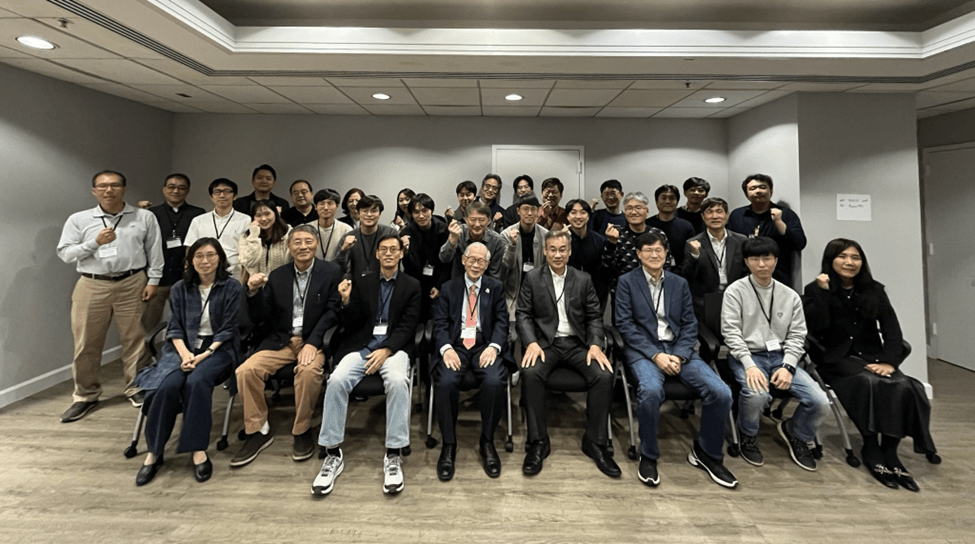
Reported by Chul Sung (President of KOCSEA)
The 2024 KOCSEA Symposium hosted by KOCSEA (Korean Computer Scientists & Engineers Association in America) brought together experts to talk about exciting new developments in science and technology. The speakers shared their research on Artificial Intelligence (AI), quantum computing, and more, giving everyone a glimpse into the future.
Dr. Tom Oh, the president of KSEA and one of the sponsors, opened the symposium. He introduced the role and status of KSEA.

The event started with Dr. Sangho Lee from the Allen Institute for AI. He talked about Molmo, a new type of AI model that combines different types of information like vision and language. His presentation showed how AI is getting better at understanding the world around us.

Next, Prof. JinHo Kim from the University of Houston-Downtown spoke about the future of remote work. He introduced the idea of a virtual office where people can work using the metaverse, AI, and virtual reality (VR). This could change how we work from home in the future, making it more interactive and fun.
Dr. Jun-Gi Jang from the University of Illinois talked about a new way to work with big data. He is developing methods to analyze large, complicated data sets more efficiently, helping scientists find useful information faster.
Dr. Gilchan Park from Brookhaven National Laboratory shared how AI can help scientists analyze huge amounts of text, like research papers. By using Natural Language Processing (NLP), AI can help researchers quickly find important information in scientific literature.
Prof. Chan-Mo Park from POSTECH gave a special presentation about the history of KOCSEA. He talked about how the association has grown and how it connects scientists and engineers from Korea and the United States to work together on important projects.

Five graduate students presented short talks for the Moon-Jung Chung Scholarship competition. Seongjong Yoo from the University of Maryland introduced VioPose, a study on 4D pose estimation for violin performance using hierarchical audiovisual inference. Kuchan Park from the University of Michigan discussed Machine Learning-based Post Event Analysis for Cybersecurity of Cyber-Physical Systems, focusing on how machine learning can improve cybersecurity. Jooyoung Yoo from the University of Southern California talked about Small Object Detection and Visualization in GIS: An Application Perspective, explaining methods for detecting and visualizing small objects in Geographic Information Systems (GIS). Suho Shin from the University of Maryland presented Ad Auctions for LLMs via Retrieval Augmented Generation, exploring how ad auctions can be optimized using retrieval-augmented generation with large language models. Finally, Bada Kwon from Northeastern University shared an Analytical Study on Region of Interest and Dataset Size of Vision-based End-to-End Lateral Control for Off-road Autonomy, examining the impact of region of interest and dataset size on autonomous vehicle control.


In the end, Seongjong Yoo won first place for the Moon-Jung Chung Scholarship. The list of scholarship recipients for 2nd place to 4th place can be found on the Scholarship page.

More than 35 researchers from various institutions, universities, and industries gathered to have a meaningful symposium.
We would like to express my deep gratitude to those who served as committee members: Professor Jun-Ho Hong (General Chair), Dr. Hong-Hwa Kim (Program Chair), Dr. Hyo-Jin Do (Recruitment Chair), Dr. Sang-Ho Lee (Recruitment Chair), Dr. Jae-Gyeom Kim (Recruitment Chair), Seongjong Yoo (Doctoral Student, Local Chair), Professor Jung-Kap Son (Scholarship/Poster Chairs), Professor Won-Jeon Kim (Finance/Publication Chair), and Seong-Rok Choi (Registration Chair).
The 2024 KOCSEA Symposium was featured in an online news (Atlanta K Media).
 KSEA e-Letters