
Reported by Chunyoung Park (Executive Director of KASSTA)
& Eun-Suk Seo (President of KASSTA)
The Korean-American AeroSpace Science and Technology Association (KASSTA) organized a Workshop on AeroSpace Science and Technology at Caltech from December 15 to 17 jointly with the Korean Space Science Society (KSSS), and NASA’s Jet Propulsion Laboratory (JPL). The primary objective of this joint workshop was to foster and strengthen collaboration between the U.S. and Korea in the field of AeroSpace Science and Technology, which is one of Korea’s 12 National Strategic Technologies.
Over 70 scientists and engineers from Korea, the United States, and Canada participated to discuss shared interests in space science and technology. The workshop was strategically scheduled to coincide with the American Geophysical Union Fall Conference, which took place in Washington, DC, from December 9 to 13, to maximize participation from Korean attendees.
The first day of the workshop began with introductions from each organization and attendee. The President of KASSTA presented Certificates of Appreciation to the President of KSSS and the Representative of JPL, as well as a Distinguished Service Award to a selected KASSTA member. Following the opening ceremony, there were 15 presentations, including short talks by early career researchers and students, aimed at exploring potential collaborative projects in various space-related fields. The dinner also provided valuable networking opportunities. Additionally, three presenters were selected to receive the Best Presentation Award, with one award given to a presenter from each organization: KASSTA, KSSS, and JPL.
On the second day of the workshop, participants shared their current and planned research in the rapidly evolving field of AeroSpace Science and Technology. The day featured a total of 24 presentations divided into two sessions on Space Science and two sessions on Space Technology. After congratulatory remarks from the LA Consul General, Certificates of Appreciation were presented to the President of KASSTA. The day concluded with a small group dinner to discuss potential cooperation plans in greater detail.
On the third day of the workshop, participants engaged in an in-depth discussion to define the missions of each group. Following this, each group presented the results of their discussions. After the closing ceremony and lunch, a technical tour of JPL (Jet Propulsion Laboratory) was conducted. A few photos and a participant’s report are given below. More photos and Video recordings are available on the KASSTA website (https://kassta.ksea.org/) and KASSTA youtube channel @KASSTA_USA.

Workshop Participant’s report:
A New Chapter in Aerospace Collaboration, with KASSTA
Reported by Joon Jo (Ph.D. Student, Texas A&M University)
From the moment that I received the email announcing the Korea-US AeroSpace Science & Technology Workshop, a new sense of excitement filled me. It was thrilling that I would be attending a workshop in Pasadena, California – home to Caltech and NASA JPL. South Korea has been known to make significant progress in the aerospace industry, especially with the recent establishment of the Korea AeroSpace Administration (KASA), and I was eager to see how Korea and the US, an unrivaled global leader in this field, can collaborate and share technologies. I immediately submitted a proposal to present my research, hoping to join the workshop and connect with fellow researchers and gain some valuable insights.
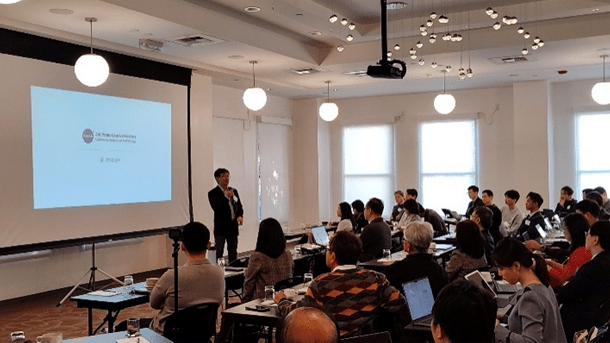
Upon arriving at LAX airport and checking into the hotel where the first day’s workshop was being held, I was greeted by the KASSTA staff who were bustling preparing for the event. It was still 2 hours away from the workshop to have a grand opening, but the atmosphere was already so heated up. The opening ceremony was a gathering of brilliant minds from across the globe, including KASSTA members from all around the US, NASA JPL researchers, academics from York University in Canada, and representatives from South Korean institutions such as KASA, Korea Astronomy and Space Science Institute (KASI), KAIST, Yonsei University, and Kyung Hee University. What truly impressed me was the tangible enthusiasm among the participants. It seemed obvious that everyone was eager to forge meaningful collaborations between Korea and the US. The presentations were insightful, and the succeeding discussions were lively and engaging. The moderator had a very hard time trying to set the program on time, but it was an interesting scene to watch. The banquet that followed at the end of all the sessions provided yet another wonderful opportunity to network with fellow researchers and learn more about their work. The food was amazing, and the dessert was one of the best that I ever had. I just wished to have an after-party for further networking in a rather casual manner, which did not occur after the banquet.

After having a good night’s sleep, the workshop continued at Caltech’s Beckman Institute in the following day. As I enjoyed breakfast on the terrace, I couldn’t help but get struck by the beauty of the campus and the significance of the building’s namesake, Arnold O. Beckman, who developed the world’s first commercially available pH meter while working as a professor at Caltech. The technical sessions on the second day were fascinating, but I was particularly thrilled at the presentations on robotic rovers designed to explore the Moon and Mars. The challenges involved in developing these autonomous vehicles are immense, and I was captivated by the ingenuity of the engineers and their struggles involved. This day’s grand finale was acknowledged with a congratulatory speech from Consul General of the City of Los Angeles.

The final day of the workshop focused on potential business collaborations between Korea and the US. There was a palpable sense of optimism as participants discussed potential projects and funding opportunities. It occurred to me that this workshop could play a role in setting the groundwork for future partnerships, as the two wheels that inspire researchers are funding and the research topic. It is also expected that KASSTA will bridge the organizations between the two nations, since we are familiar with both cultures and systems. This workshop was finalized with the NASA JPL tour. As I toured the lab, I was in awe of the cutting-edge facilities and the brilliant minds behind the missions. The control room, where engineers communicate with spacecraft across the solar system, was particularly impressive. Overall, this workshop was a truly inspiring experience. I could leave feeling so optimistic about the future of space exploration and eager to contribute to the growing collaboration between Korea and the US. As Gordon Moore predicted, the world is changing rapidly, nowadays even much more than in the recent past, and the space industry is at the forefront of this change. It is indisputable that we continue to invest in research and development in this field.
 KSEA e-Letters