Seungheon Lee
President of UT YG group
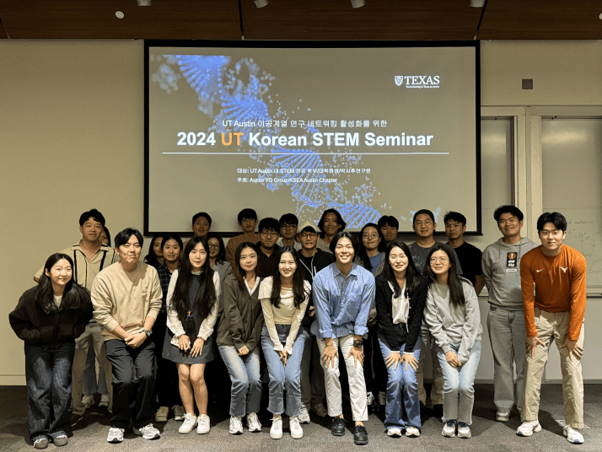
On November 14, 2024, the UT STEM Seminar, a flagship event of the Korean-American Scientists and Engineers Association (KSEA) Austin Chapter, took center stage at the University of Texas at Austin, drawing a vibrant audience of researchers, students, and postdoctoral scholars. Held in NHB 1.720, the seminar was hosted by the Austin Young Generation (YG) group and aimed to create a dynamic platform for members to share their cutting-edge research while fostering interdisciplinary dialogue and collaboration.
The evening showcased the academic talents of 11 students from diverse disciplines at UT Austin, with topics spanning basic and applied sciences. Attendees delved into a variety of groundbreaking research, including advancements in regenerating Retinal Pigment Epithelium, the revolutionary applications of CRISPR/Cas12 for gene editing, innovative game theory strategies to optimize communication networks, and sustainable approaches to reusing construction materials. Each presentation was thoughtfully crafted to make complex ideas accessible, ensuring that participants, regardless of their field, left with a clear understanding of the key takeaways.
The 3-hour seminar, held from 6 PM to just after 9 PM, attracted over 40 attendees, a diverse mix of undergraduate and graduate students, postdoctoral researchers, and professionals. This diversity enriched the event, fostering vibrant discussions and inspiring participants to broaden their knowledge beyond their areas of expertise. The audience included four undergraduate students, approximately 23 graduate students, and 13 postdoctoral scholars, creating a melting pot of perspectives that enhanced the quality of interactions.
A hallmark of the seminar was its emphasis on interdisciplinary collaboration. Following each presentation, engaging Q&A sessions allowed attendees to exchange ideas, discuss challenges, and brainstorm solutions. These discussions not only deepened understanding but also opened doors for future partnerships between research groups. Presenting to an audience outside their own fields challenged the speakers to refine their communication skills, enabling them to articulate their findings more effectively and gain valuable feedback.
The seminar also reinforced the strong sense of community within the KSEA Austin Chapter. By bringing together a diverse group of researchers, the event encouraged networking and strengthened professional connections. Many attendees remarked on the value of such opportunities to interact with peers across different disciplines, paving the way for collaborative initiatives that could have a lasting impact.
As the evening concluded, participants reflected on the seminar’s success in fostering intellectual exchange and accessible scientific communication. The event underscored the importance of creating platforms that bridge academic silos, enabling researchers to learn from one another and inspire innovation. Looking ahead, the Austin YG group plans to build on this momentum by hosting similar events in the future. By continuing to promote interdisciplinary dialogue and a sense of community, the UT Korean STEM Seminar stands as a testament to the power of collaboration in driving research forward. Participants left the seminar not only with new insights but also with strengthened networks and the potential for groundbreaking collaborations that could shape the future of science and engineering.
 KSEA e-Letters