On April 29 (EST), a joint seminar on AI, IoT, cybercrime, and cyber defense was held, co-hosted by the Korean Society of Criminology in America (KOSCA) and the Korean National Police University (KNPU), and sponsored by the Korean-American Scientists and Engineers Association (KSEA).

This seminar spotlighted cutting-edge innovations in artificial intelligence (AI) and the Internet of Things (IoT), with a particular focus on cybersecurity applications in both the United States and Korea. As digital threats, especially those involving cryptocurrency-related cybercrime, continue to grow globally, the event underscored the need for international collaboration among law enforcement, academic researchers, and field professionals.
Bringing together experts from AI, IoT, cybersecurity, crypto investigations, law enforcement, the private sector, and academia, this interdisciplinary forum explored emerging technologies and strategies to combat cybercrime, strengthen digital defenses, and build cross-border partnerships.
This seminar provided a global platform for practitioners and scholars to engage in inclusive, forward-looking discussions on current trends and future challenges in AI, IoT, and cybercrime, particularly within the context of U.S.–Korea cooperation. Continue reading for a summary of the event!
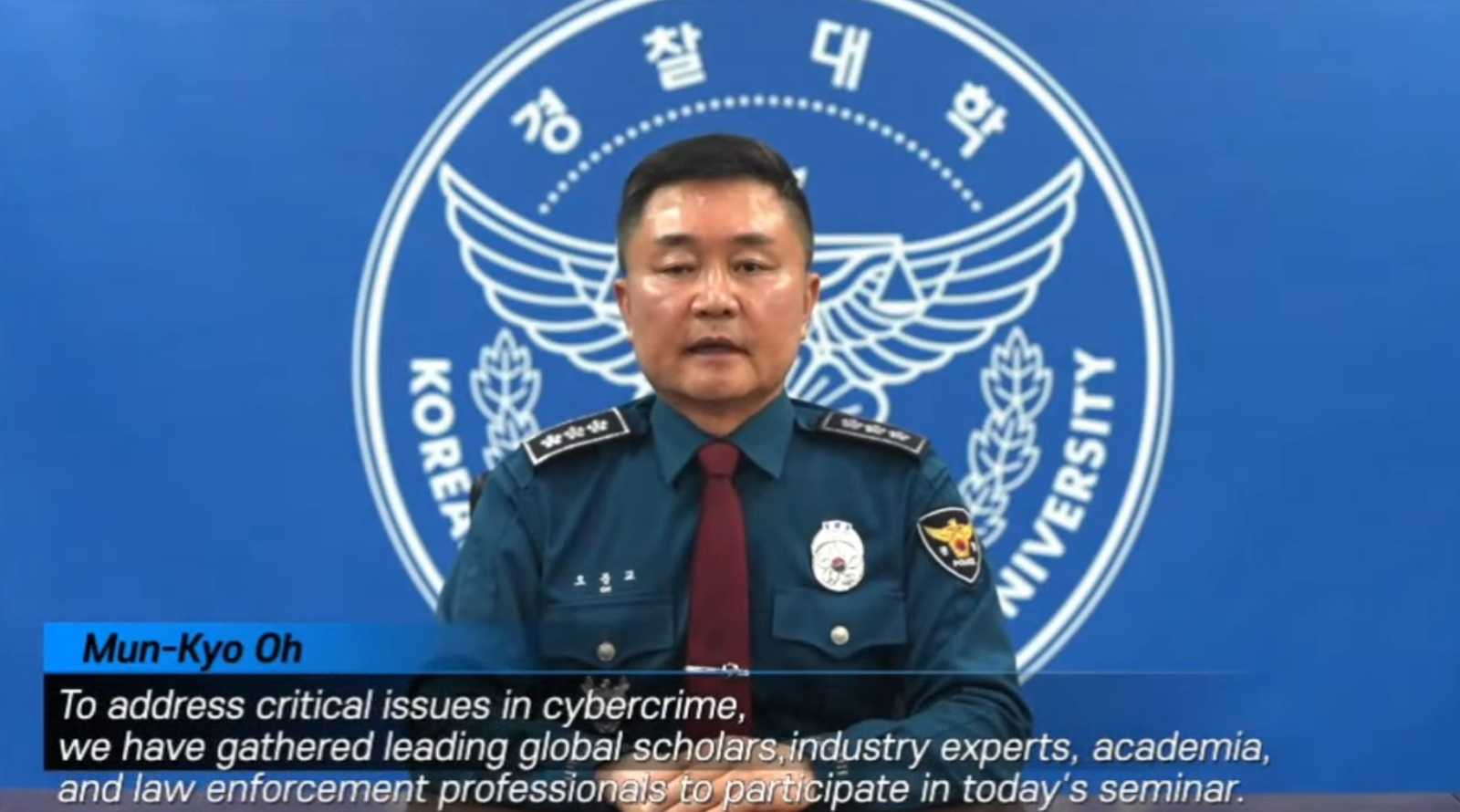
The Opening remarks were given by the President of the Korean National Police University, Mr. Mun-Kyo Oh.
Mr. Oh highlighted the rapid advancement of technologies like AI, IoT, and drones, emphasizing the new security challenges they bring, including IoT device hacking and drone-related threats. He stressed the importance of global collaboration among scholars, industry experts, and law enforcement to address cybercrime. He expressed hope that the seminar would foster knowledge-sharing and partnerships, and reaffirmed KNPU’s commitment to supporting both academic and practical progress in public safety on a domestic and international scale.
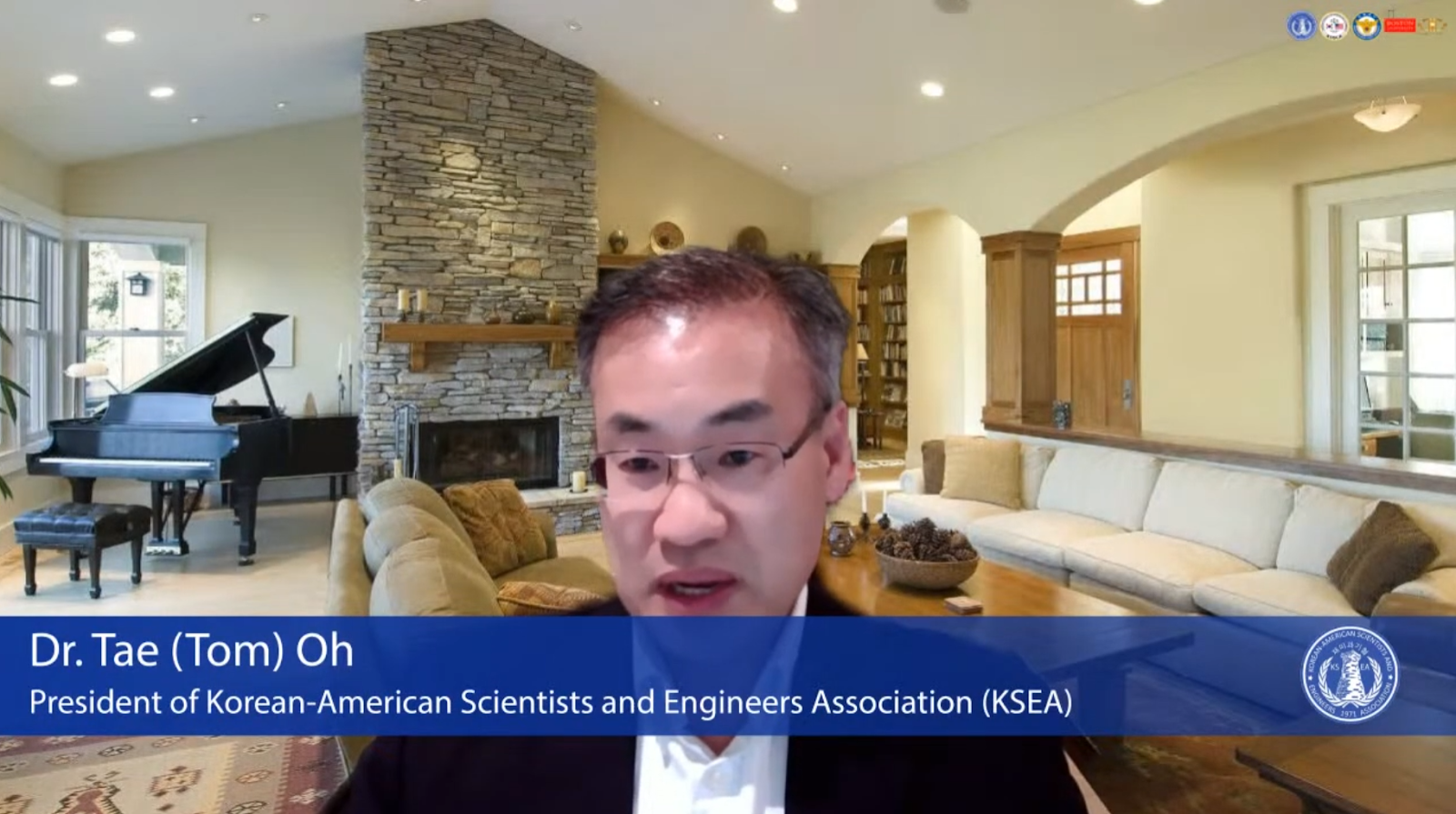
Next, Dr. Oh, speaking on behalf of the Korean-American Scientists and Engineers Association (KSEA), welcomed attendees to the seminar. He emphasized the importance of international collaboration and cross-disciplinary efforts to address increasingly sophisticated digital threats. Highlighting the seminar’s role in uniting experts from law enforcement, academia, industry, and government, Dr. Oh expressed pride in KSEA’s support of initiatives that promote global security, public trust, and responsible innovation. He thanked the co-hosts, speakers, and participants and encouraged a productive and insightful seminar.
Next, Dr. Choi’s presentation focused on the evolving threat landscape of cybercrime, particularly how cyber-physical systems, IoT devices, and AI-driven technologies are exploited by criminals. He discussed recent trends in illicit online activity, including the rise of darknet drug markets since Silk Road, highlighting Hydra Market as a major case that facilitated over $5 billion in illegal Bitcoin transactions before its takedown. Dr. Choi detailed high-profile investigations such as the DOJ-led Hydra Market seizure and Operation SpecTor, which disrupted darknet opioid trafficking. He also explained how scams like “pig butchering” and AI-driven credential harvesting are becoming more sophisticated. The presentation emphasized the increasing convergence of drug trafficking, money laundering, and child sexual abuse material (CSAM) through cryptocurrency, urging stronger international law enforcement collaboration.


To combat these threats, Dr. Choi outlined an investigative study conducted by his Center for CIC team, which analyzed darknet-linked Bitcoin addresses termed “Seed Addresses” to trace financial transactions associated with darknet drug sales and broader criminal networks. Using blockchain forensics and tools like Maltego, the team flagged high-risk wallets tied to hacking, scams, and CSAM. They identified core markets linked to multiple darknet sites, indicating centralized criminal operations. The analysis revealed alarming trends: 63.9% of transactions involved money laundering mixers, 41.7% were linked to CSAM, and others connected to terrorism and sex trafficking. Dr. Choi concluded with a call for greater collaboration between law enforcement, researchers, and industry to develop AI-driven monitoring systems, enhance blockchain analysis capabilities, and equip investigators with the tools and training needed to disrupt organized cybercrime globally.
Following the presentation, Dr. Tom Oh and Dr. Choi engaged in an insightful discussion on US-Korea collaboration (moderated by Dr. Insun Park). They shared key examples of US-Korea research and provided advice for the researchers and practitioners seeking to engage in such partnerships.


Dr. Wook Kang’s presentation, “Drone Warfare Readiness: Advancements in Anti-Drone Technology and Drone Forensics,” explored the rapid evolution of drone warfare, particularly highlighted by the Russo-Ukrainian conflict, where the scale and sophistication of drone use have surged dramatically. He details how both sides have deployed thousands of drones monthly, with Ukraine investing heavily in domestic production and developing advanced models. Technical advancements, including resilient navigation systems and modular designs, are expanding operational capabilities and challenging traditional defense systems.
Dr. Kang then covered anti-drone strategies and the emerging field of drone forensics. Kang outlines the dual approach to countering illegal drone activities: military methods focus on detection, tracking, and defeat, while civilian responses emphasize management and observation. He then stressed the necessity for advanced forensic tools to address encrypted data and maintain evidence integrity, underscoring the critical role of drone forensics in mitigating security threats, supporting justice, and adapting to the complex challenges posed by the proliferation of drone technology.

Dr. Myunghoon Roh’s presentation, “Exploring Current AI Applications in the U.S. Criminal Justice System,” provided a comprehensive overview of how artificial intelligence is transforming various facets of criminal justice in the United States. He began by clarifying the definitions and distinctions between AI, machine learning, and deep learning, thereby emphasizing that AI is not a singular technology but a broad field aiming to simulate human intelligence. Roh highlighted both the opportunities and risks associated with AI adoption, noting that while these tools can enhance efficiency, reduce costs, and expand capabilities, there are misconceptions about their true potential and the investment required for effective implementation.
Dr. Roh also highlighted specific AI applications across law enforcement, courts, and corrections. In law enforcement, AI-powered tools such as automated license plate readers, facial recognition systems, and predictive policing models. Dr. Roh underscored the need for robust accountability measures, clear policies, and ongoing evaluation to ensure that AI adoption advances justice while safeguarding against bias and protecting individual rights.

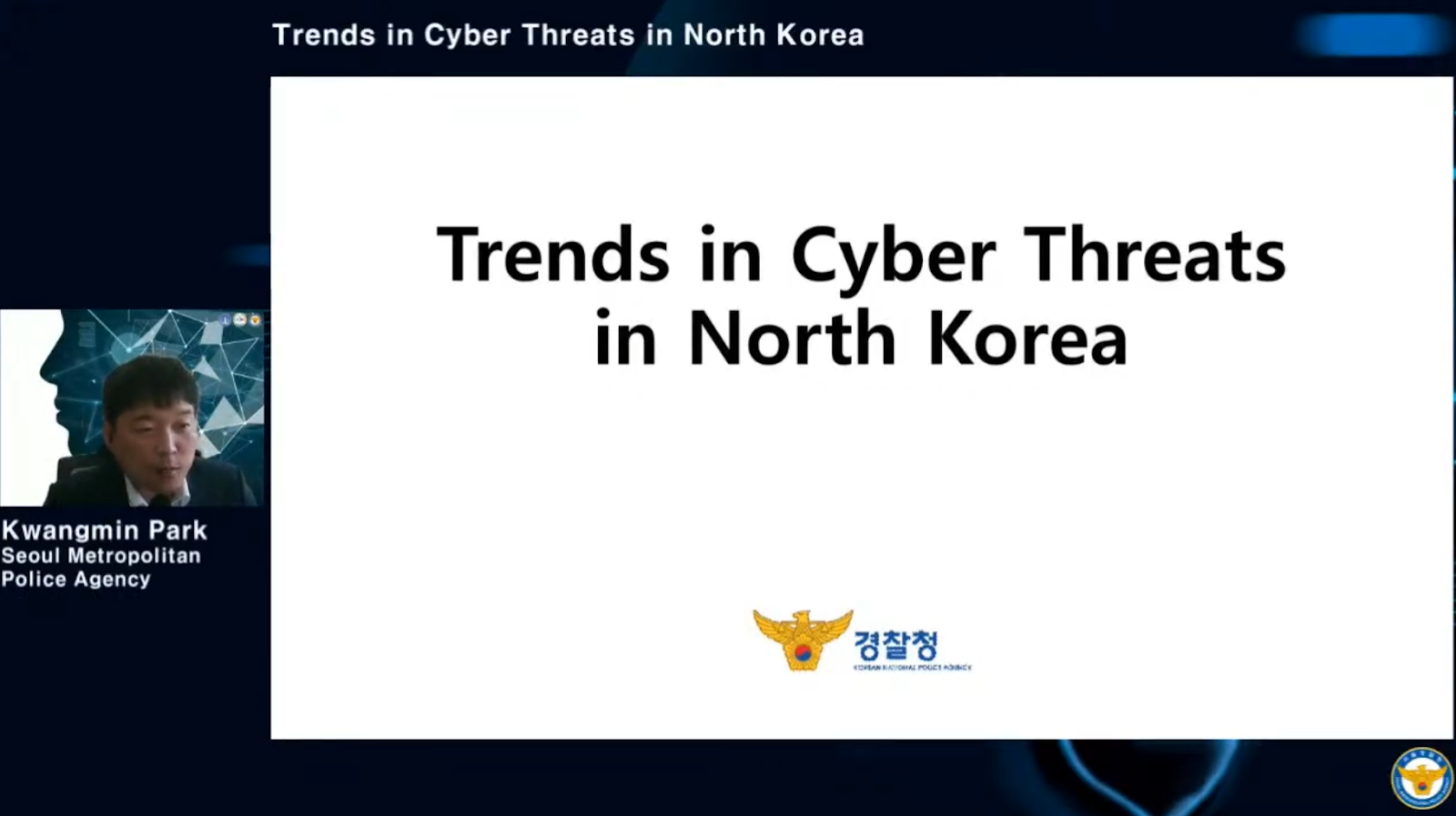
Mr. Park Kwangmin (Seoul Metropolitan Police Agency) shared a unique perspective on the Trends in Cyber Threats in North Korea. Specifically, he explained the major hacking groups-Kimsuky, Lazarus, and Andariel-and their operational tactics and targets. He outlined how these groups have been active since the late 2000s, each specializing in different attack vectors: Kimsuky is known for spear-phishing and targeting diplomatic and governmental entities, Lazarus for high-profile financial and destructive attacks like the Sony Pictures hack and the Bangladesh Central Bank heist, and Andariel for targeting military and defense sectors with ransomware and data breaches. Mr. Park provided case studies demonstrating the groups’ techniques, such as phishing, supply chain attacks, and cryptocurrency theft, illustrating how North Korean cyber operations have expanded globally to include the United States, Japan, and South Korea.
Also, Mr. Park discussed the technical sophistication and adaptability of these threat actors, highlighting their use of zero-day vulnerabilities, fake identities, and social engineering to bypass security measures. He concluded by stressing the persistent and evolving nature of North Korean cyber activities, urging organizations to adopt comprehensive security frameworks and remain vigilant against increasingly sophisticated attacks.
Lastly, Dr. So’s presentation addressed the urgent need for advanced ballistic protection in the context of rising gun violence and the increasing deployment of patrol robots in law enforcement. Dr. So emphasized that for patrol robots operating continuously in diverse and harsh environments, ballistic armor must be weather-resistant, shatter- and ricochet-proof, lightweight, and thin to maintain operational effectiveness and maximize coverage area.
To overcome these limitations, Dr. So introduced AtoMe’s innovative solution: a patent-pending, AI-driven process that reinforces metals with ceramic nanoparticles, significantly enhancing strength, hardness, and durability while reducing weight by 30%. This technology enabled more robust protection for patrol robots, with the potential to extend to body armor, vehicles, and military applications. Dr. So concluded that AtoMe’s approach not only improved the survivability and functionality of patrol robots in active shooter scenarios but also contributed to broader public safety by enabling more effective, scalable, and intelligent ballistic protection solutions.

The event culminated with a thoughtful discussion session, moderated by Dr. Mijin Kim. The Q&A discussion featured targeted questions for each presenter, focusing on the practical challenges and future directions of their research. Dr. Kang was asked about the limitations of current drone detection methods and how his institute is leveraging AI and sensor fusion to improve accuracy, especially in complex urban environments. He explained that each detection method, such as RF and radar, has inherent weaknesses, and integrating multiple methods using AI helps compensate for these gaps. He highlighted the importance of combining technological solutions with traditional approaches, such as community reporting, and described ongoing projects that use AI to assess vulnerabilities and develop tailored security manuals for critical infrastructure like power plants.
Dr. So was then asked about the realistic capabilities of smart ballistic armor for patrol robots in high-risk operations and the technical barriers. He acknowledged that while advances in AI and robotics have enabled the deployment of robots in law enforcement, significant challenges persist. Key limitations include energy efficiency, environmental adaptability, and effective human-machine teaming. Dr. So emphasized that, although current technology allows for lightweight, durable, and custom-fit armor using advanced materials and additive manufacturing, further progress is needed to optimize these systems for continuous operation in diverse environments.
Superintendent Park addressed questions about North Korean cyber threats, emphasizing the increasing sophistication and persistence of state-sponsored hacking groups like Kimsuky, Lazarus, and Andariel. He explained that these groups have expanded their operations globally, targeting not only government and military sectors but also financial institutions and critical infrastructure.
Dr. Roh was asked about the practical challenges and ethical considerations surrounding the use of artificial intelligence in the criminal justice system. He explained that while AI technologies such as predictive policing and automated risk assessment have the potential to improve efficiency and decision-making, they also raise significant concerns about bias, transparency, and fairness. Dr. Roh emphasized the importance of rigorous validation and oversight to ensure that AI systems do not perpetuate or exacerbate existing inequalities. He also highlighted the need for collaboration between technologists, legal experts, and policymakers to develop clear guidelines and accountability mechanisms, ensuring that AI serves the goals of justice and public trust.

Special thanks to Mr. Gibeom Park for overseeing the rehearsal/event to designing the event flyer, and virtual background. We owe the success of this event to your help!
 KSEA e-Letters