Reported by Dr. Deok-Ho Kim (President of KBMES
and Professor of Biomedical Engineering at Johns Hopkins University)
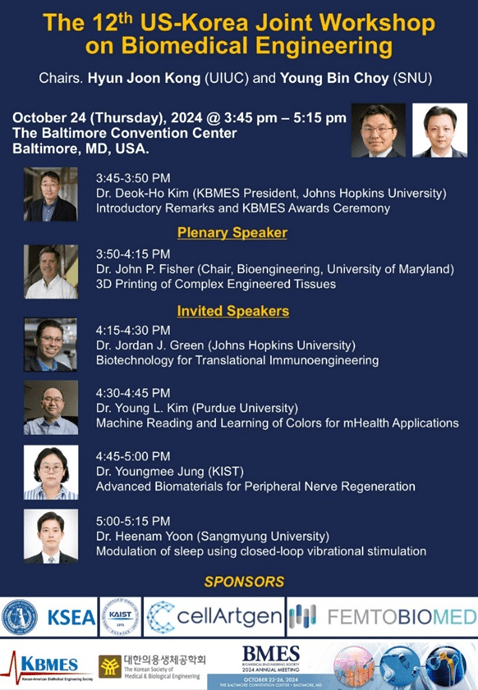
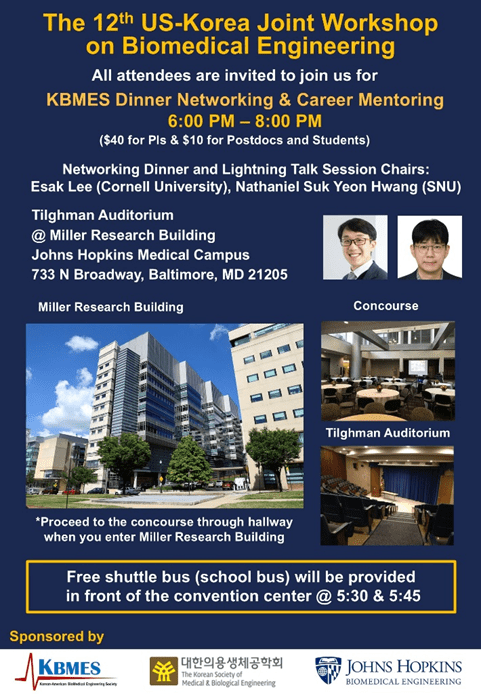
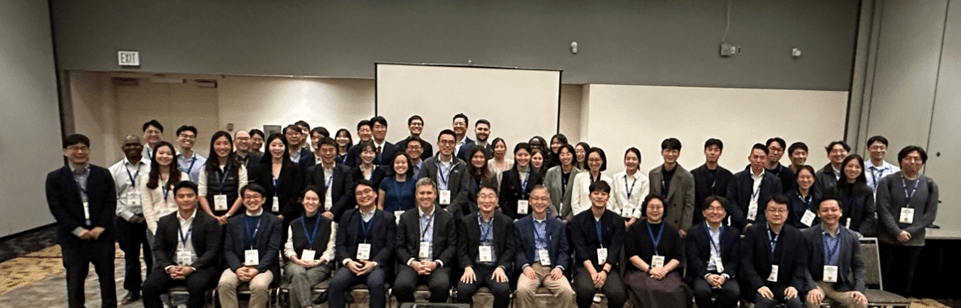
The Korean-American Biomedical Engineering Society (KBMES), in collaboration with the Korea Society of Medical and Biological Engineering (KOSOMBE), successfully hosted the 12th Korea–US Joint Biomedical Engineering Society Workshop on October 24, 2024, at the Baltimore Convention Center. As a featured session of the 2024 Annual Meeting of the Biomedical Engineering Society (BMES), this high-profile workshop brought together over 150 faculty, postdoctoral fellows, graduate students, and industry professionals from leading institutions in the U.S. and Korea for a half day of impactful scientific exchange, career mentoring, and cross-border collaboration.
KBMES’s Mission to Bridge Biomedical Engineering Across Borders
Since its establishment in 2013 under the Korean-American Scientists and Engineers Association (KSEA), KBMES has become a vital platform for promoting international collaboration in biomedical engineering. The society is committed to:
- Advancing collaborative research and education between Korea and the U.S.;
- Mentoring young scholars and trainees in biomedical engineering field;
- Driving biomedical innovation through academic, clinical, and industry partnerships.
Through its annual workshops, quarterly webinar series, and dedicated mentoring activities, KBMES continues to build bridges across academia, industry, and government sectors in both countries.
Scientific Highlights from the 12th KBMES Workshop
Co-chaired by Dr. Hyun Joon Kong (University of Illinois Urbana-Champaign) and Dr. Young Bin Choy (Seoul National University), the 2024 KBMES Workshop commenced with opening remarks from Dr. Deok-Ho Kim (Johns Hopkins University), President of KBMES. In his address, Dr. Kim reflected on the society’s ten-year legacy of fostering scientific collaboration between Korea and the United States and highlighted the growing importance of international collaboration in biomedical engineering field.
The workshop program featured a plenary lecture by Dr. John Fisher, Chair of Bioengineering at the University of Maryland and a world leader in tissue engineering and regenerative medicine. Dr. Fisher presented cutting-edge 3D bioprinting strategies for fabricating functional musculoskeletal tissues. He highlighted developments in hybrid bioinks, perfusable constructs, and dynamic culture systems with a focus on translational potential.
The program continued with four invited talks from internationally renowned researchers:
- Dr. Jordan Green (Johns Hopkins University) discussed the development of biodegradable polymer platforms for the targeted delivery of mRNA and therapeutic proteins. His presentation highlighted significant progress in precision immunotherapy, particularly for cancer and autoimmune diseases.
- Dr. Young L. Kim (Purdue University) showcased AI-enhanced optical biosensing systems that interface with smartphones to deliver low-cost, point-of-care diagnostics. His team’s work enables colorimetric screening of key health biomarkers, such as hemoglobin and cortisol, supporting broad accessibility in mobile health monitoring.
- Dr. Youngmee Jung (Korea Institute of Science and Technology, KIST) presented her group’s advancements in peripheral nerve regeneration using electroconductive hydrogel scaffolds embedded with neurotrophic factors. Her research exemplifies the convergence of bioelectronics and regenerative biomaterials.
- Dr. Heenam Yoon (Sangmyung University), recipient of the 2024 KOSOMBE Young Investigator Award, introduced a novel closed-loop wearable device that uses real-time EEG monitoring to deliver personalized vibrational stimuli during sleep. This innovative system has the potential to enhance slow-wave sleep, improve cognitive performance, and reduce stress—opening new frontiers in neuromodulation and digital therapeutics.
Collectively, these distinguished presentations highlighted the depth and breadth of emerging technologies shaping the future of biomedical engineering on a global scale.
KBMES Young Investigator Award Ceremony
In addition to the scientific program, the 2024 KBMES Young Investigator Award Ceremony highlighted the society’s ongoing commitment to recognizing and supporting emerging leaders in biomedical engineering.
The inaugural 2024 KBMES Young Investigator Awards were presented to:
- Dr. Esak Lee, Assistant Professor at Cornell University, for his groundbreaking work in vascular engineering and organ-on-chip platforms.
- Dr. Su Jin Heo, Assistant Professor at the University of Pennsylvania, in recognition of her innovative research in mechanobiology and musculoskeletal tissue engineering.
- Dr. Jina Ko, Assistant Professor at the University of Pennsylvania, for her pioneering work on diagnostic microtechnologies and single-cell analysis, advancing precision.
Additionally, the 2024 KBMES Young Innovator Award was awarded to:
- Dr. Inho Kim, Postdoctoral Fellow at the California Institute of Technology (Caltech), for his outstanding research on wearable biosensor technologies.
These awards celebrate outstanding early-career investigators who exemplify research excellence, innovation, and leadership within the Korean–American biomedical engineering community. Each recipient represents the next generation of scholars working to bridge fundamental science and clinical impact across disciplines and borders.
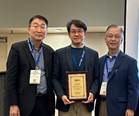
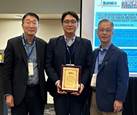
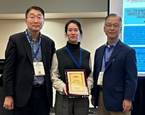
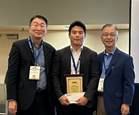
Presentation of the 2024 KBMES Young Investigator and Young Innovator Awards at the 12th KBMES Workshop.
From left to right: Dr. Esak Lee (Cornell University), Dr. Su Jin Heo (University of Pennsylvania),
Dr. Jina Ko (University of Pennsylvania), and Dr. Inho Kim (California Institute of Technology).
Awards were presented by Dr. Deok-Ho Kim (President of KBMES, Johns Hopkins University)
and Dr. Michael Cho (University of Texas at Arlington, KBMES Award Committee Chair).
“Korean Night” Networking Dinner & Career Mentoring
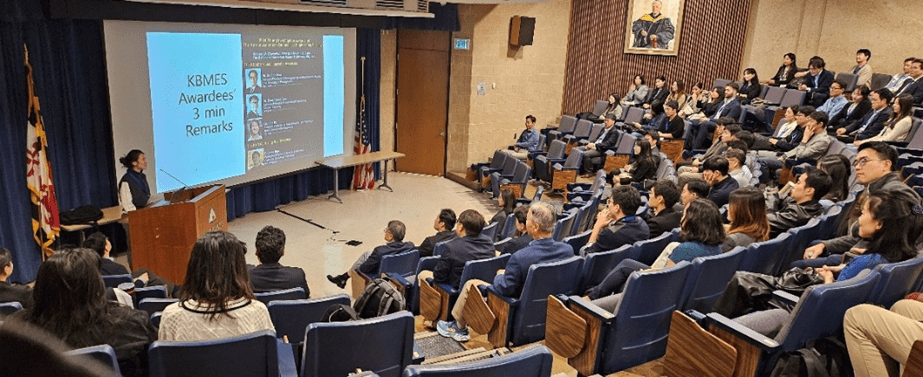
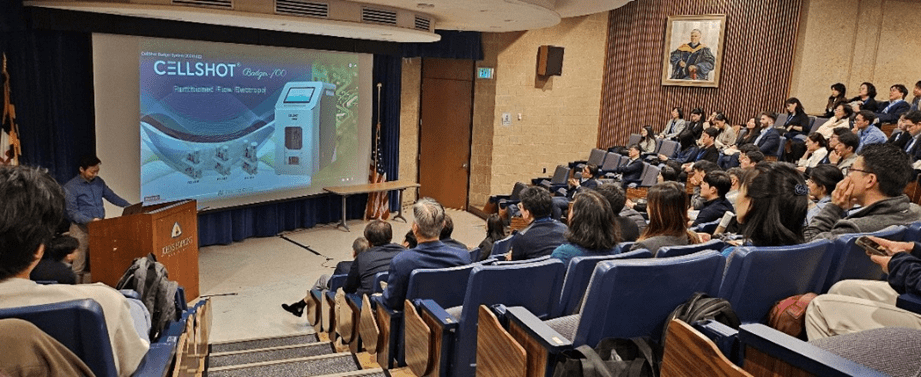
Following the formal scientific program, participants gathered at the Tilghman Auditorium on the Johns Hopkins Medical Campus for the KBMES Networking Dinner and Career Mentoring Session. The evening, co-chaired by Dr. Esak Lee (Cornell University) and Dr. Nathaniel Suk Yeon Hwang (Seoul National University), brought together over 100 attendees, including faculty, postdocs, and students from Korea and the U.S.
The program began with a lightning talk session, where selected trainees gave concise, high-impact presentations on their research and career goals, followed by engaging Q&A that fostered peer learning and visibility for early-career investigators.
This was followed by mentorship forums featuring academic and industry leaders who offered practical guidance on faculty job searches, entrepreneurship, international collaborations, and work–life balance.
The evening concluded with a networking dinner, which provided an informal and welcoming setting for cross-institutional and cross-generational dialogue. Attendees engaged in dynamic conversations around research, training, and international collaboration, strengthening the bonds within the Korean-American biomedical engineering community.
Organized by a Distinguished International Committee
The success of the 12th Korea–US Joint KBMES Workshop was made possible through the dedicated leadership of an exceptional international organizing committee. The workshop was chaired by Dr. Deok-Ho Kim (Johns Hopkins University) and supported by a stellar organizing committee composed of esteemed leaders from both the U.S. and Korea. Their collective efforts ensured a program of high scientific caliber, inclusive engagement, and seamless coordination.
- U.S.-based members: Dr. Hanjoong Jo (Emory University), Dr. Mike Cho (University of Texas at Arlington), Dr. Ho-Wook Jun (University of Alabama at Birmingham), Dr. Min-Ho Kim (Kent State University), Dr. Deok-Ho Kim (Johns Hopkins University), Dr. Jungkyu Kim (University of Utah), Dr. James Moon (University of Michigan), Dr. Hyunjoon Kong (University of Illinois Urbana-Champaign), Dr. Clare Kim (Johns Hopkins University), Dr. Esak Lee (Cornell University), Dr. Eun Ji Chung (University of Southern California), Dr. Chi Hwan Lee (Purdue University), Dr. Su Jin Heo (University of Pennsylvania)
- Korea-based members: Dr. Jennifer Shin (KAIST), Dr. Youngbin Choy (Seoul National University), Dr. Seung Woo Cho (Yonsei University)
Looking Ahead: KBMES Workshop at BMES 2025 in San Diego
Building on this year’s success, KBMES will host its 13th Annual Korea–US Joint Workshop on October 9, 2025, at BMES 2025 in San Diego, California. The upcoming workshop will spotlight next-generation biomedical engineering technologies including organ-on-a-chip systems, AI-driven diagnostics, and immunoengineering, while expanding cross-border partnerships and training opportunities. All KSEA and BMES members are warmly invited to join this growing international network of biomedical engineering leaders.
 KSEA e-Letters